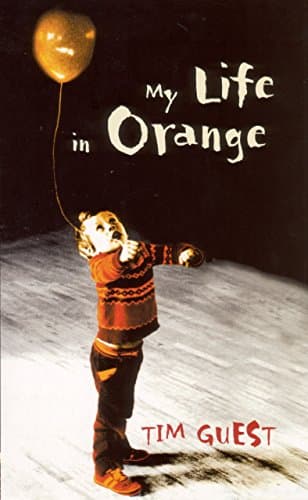
Tim Guest, My Life in Orange
Value For Money
Tim Guest, My Life in Orange
When you purchase through links on our site, we may earn an affiliate commission. Here's how it works.
User Reviews
Value For Money
One Of The Reasons That 'my Life In Orange 'is A
One of the reasons that 'My Life in Orange 'is a good autobiography is that Tim Guest has had an interesting life.
That may sound obvious but I am always amazed at the people who feel it is appropriate to write their autobiography about their uninteresting upbringings in Hounslow to middle class and uninspiring parents. Still, perhaps that ' s just me.
The other reason that this is a good autobiography is that Tim Guest is a writer.
That is to say, he can write. This seems like an increasingly rare trait in the burgeoning biography section of the local bookshop where grade C in an English Language CSE is a bonus and ghost writers lurk in all the dark corners.
So we here have an interesting life story to tell by a chap worthy of wielding a biro. All the makings as neither of grandmothers ever said.
If you were anything more than a foetus in the early seventies then you probably remember The Orange People, or the sannyasins, as they termed themselves. They would dress only in the colours from orange through to burgundy; they lived on big communes and followed the teachings of Bhagwan (which translates as The Blessed One). He was an aging Indian who had a fascinating mishmash of eastern mysticism, bogus nonsense and sexual psychology to fan the flames of his follower ' s adoration.
I ' ve never known that much about the lives of the sannyasins but I confess to some admiration for them there is an integrity in their attempts to find some meaning in their lives; they saw problems in the modern world and they wanted to resolve them. They felt themselves to be on a liberating voyage of self-discovery.
Of course it is very easy for us to mock them and their ambitions for a different type of world with retrospect. Bhagwan encouraged both risk-taking and the shaking off of taboos which serves to provide the reader with copious amounts of classes that encourage screaming, that encourage sex, that encourage crying and that encourage silence. In fact Bhagwan himself stopped speaking for a period of three years.
Yet some disquiet finds the reader through all this funny stuff in the realisation that the sannyasins were so keen to liberate their children and to shake off the shackles of the few remaining taboos that some of the men were taking their own daughter ' s virginity, or allowing their friends to do so with a maddening theory of justification.
I suppose I had never thought about the implications of what growing up as a small child in these communes would be. That ' s what happened to Tim. Tim would live variously in communes in Suffolk, in Oregon in Pune and in Cologne. In some senses he had two or perhaps three hundred parent figures and in another sense he had the freedom to run around entirely as he chose to, as his liberty and freedom were encouraged on the communes.
Parents were encouraged by Bhagwan to let their children go, and not to allow any clinginess to their biological parents. So Tim, or Yogesh as he became known, slept in a room with the other kids, not with his mother - and spent the days running wild in the great expanses of land or finding ways to entertain himself and his friends.
This is such an enjoyable part of the book. The security of commune life does in some ways allow the young children to do exactly as they please: but in truth offers relatively little opportunities for excitement. So the kids make up more and more ingenious and ridiculous ways to entertain themselves. Their vulnerability, the heightened importance of their childhood friendships and their real innocence is fascinating to witness unfurl in an environment where innocence is not encouraged! They witness adults having sex from a very early age and are more than used to inter-relationship liaisons and nudity. Yet because they are alone, or in the company of other children only their innocence and innocent confusion about the world is tantamount.
That is the happier side of this read and the charming elements of Tim ' s childhood veritably whisk the reader through the biography at quite a rate. However, there is a far more pervasive and downright upsetting view of this childhood which really takes the upper hand as the work moves on.
Tim wants his mum. All his friends want their mums too. They just do. They can ' t help it.
I nearly wrote that this was 'poignant 'but in truth I need to crank that up a good bit, it ' s downright painful.
Tim ' s mother, Ma Prem Vismaya (Mother:Love:Wonder) is increasingly successful in the hierarchy of the communes. Of course there is a political agenda here, just as there is when more than three people get together for any other reason. Here to get close to Bhagwan is the greatest aspiration, and the most obvious way to enter his 'inner circle 'is by successfully reaching out with his message to as many people as possible. So working on the internal newspapers, running classes on Bhagwan ' s path to enlightenment, even setting up new communes is all in the remit of Ma Prem Vismaya.
She is one busy woman. She is also in an environment in which unnecessary contact with her biological child is discouraged. However, there are some tear-jerking moments in which Tim apparently begins to understand that his mother does not love him, doesn ' t even really like him. The real stinger is when he is on the phone to her and doesn ' t put it down immediately only to hear her doing an exaggerated imitation of his whining request to see her to faceless laughing friends. That hurt.
This interplay of Tim believing that his mother doesn ' t love him and the reader knowing that this small child, this narrator is by definition unable to put himself in his mother ' s shoes is deftly and delicately managed. Given that this is not fiction but autobiography I was doubly impressed with this. It was also so very difficult to read.
Could it really be that this woman who so desired enlightenment, liberation and freedom had unwittingly condemned her own son to a lifetime of insecurity and upset? The irony seeps through every page.
Of course there is much more narrative 'plot 'than this as Tim faithfully recounts trips to see his father in the US, sexual encounters of the adolescent fumbling kind and good strong friendships made. What ' s more this is far more than an autobiography of one man, it is also a faithful 'biography 'of the Orange people, of Bhagwan, or corruption, of blind faith, of wanting so much to believe and of the shame and despair at the ultimate fall of the house of Rajneeshpuram.
This is no 'Life Changing 'book, it ' s not supposed to be. Nowhere does he come across as bitter or preachy. This is simply autobiography at its best. Tim Guest balances the good with the bad amazingly well and draws no conclusions himself: he simply offers it to us as an honest appraisal of how he remembers it all happening.
Whilst his mother hunts for eternal happiness her son can generally be found searching for earthworms, and both the humour and the sadness of that mad juxtaposition will touch the reader.
What a wonderful find. It cost me £12.00 for the paperback Granta version because I was stupid enough to pay the full cover price at Waterstones. If you want to try to find a cheaper copy us the ISBN number 1-86207-632-4 and look for a rather charming image of a young boy absorbed in the activity of the orange balloon at the end of his piece of orange string.
Q&A
There are no questions yet. Be the first to ask a question.