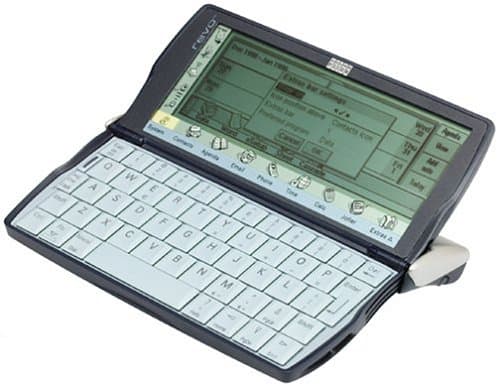
Psion Revo
Battery Life
Value For Money
Psion Revo
When you purchase through links on our site, we may earn an affiliate commission. Here's how it works.
User Reviews
Value For Money
Battery Life
The Psion Revo Pda Is An Eye-catching Machine, Wit
The Psion Revo PDA is an eye-catching machine, with the stylish design and high-quality build that is arguably lacking in most of the competition. Battery life feels unusually short while a lack of USB support is disappointing, however the Revo remains an essential buy, especially for those seeking a high-quality PDA with a keyboard and word-processor.
got it right on this review matey, the revo plus with twice the memory is available for only £150 now (john lewis) so the memory issue is slightly resolved (16 meg now). the serial port isn't a severe disadvantage as it's a doddle to hook it up to a pc with the supplied Psiwin cd and docking cradle.
if you don't have upwards of 400 quid to spend on a fully featured multimedia all-singing dancing creature then a revo is great value, £99 from carphone warehouse.
the lack of a backlight is disappointing, especailly psion researched the possibility and thought it wasn't needed.
if you have a nokia 8210 and a basic pc at home, you can upgrade the standard revo with a web browswer ( turning picture loading off improves spee ) and can be surfing in no time, the onboard e-mail software is simple to set up too and if you need to send 1 pre-written e-mail, it'll only take about 40 seconds using the infra red port.
the battery should last a week, but that's if you hardly ever use the thing - i wouldn't want to be parted from my workhorse of beast - so it lasts about 10 hours with heavy heavy use.
Agree with the review. Memory is short at 8 MB in Revo and more so if one has applications like Route/ Street planner. Revo plus would be better at 16 MB. Word processor & spreadsheet are excellent. The email application is superb & in paricular the SMS capability built into the mail application. Conversion from Microsoft file formats to EPOC & vice versa is simple, just drag & drop.
Value For Money
Battery Life
I Have Been A Dedicated Psion User Since I Bought
I have been a dedicated Psion user since I bought a Psion 3a 7 years ago (& subsequently a Psion 3c), but will be no longer. This is a poorly designed machine; the screen is barely readable except in very good lighting conditions, the battery performance is poor and the charger comes with a very short cable and will only work off 240v. If the unit is recharged as suggested in the manual, the NiMh batteries fail early (at 10mths in the case of 2 separate machines).
I have always found the most useful apps to be the database & spreadsheet and am therefore irritated to find that the primary hot-link keys no longer provide links to these apps, but instead go to new programs such as contacts & phone, which seem similar and therefore a waste of space.
I strongly recommend avoiding this product.
Value For Money
Battery Life
The Psion Revo Plus Handheld / Mini-laptop Could B
The Psion Revo Plus Handheld / mini-Laptop could be a great contender in the present handheld - PDA market place. It form-factor w/ the fold-out keyboard and the third party software support out on the web for it, really those make it a gem. I have provided several TomeRaider eBooks on my web page for the Psion Revo also.
Byron
Value For Money
Battery Life
Seven Years Ago I Bought A Pc Which Was Powered By
Seven years ago I bought a PC which was powered by a 25Mhz processor and boasted 4Meg of RAM. This little baby runs at 36Mghz and has four times the memory! This item is far superior to the handheld devises that are currently on offer in the market, the keyboard makes it really user friendly, a real pocket word processor! Also the price makes the Revo Plus very desirable by comparison. There is ample software available and with that 16meg of RAM there is plenty of room to store it. If Psion were to offer this product with a colour screen and more sound features including a voice recorder it would be untouchable, even at double the price.
Value For Money
Battery Life
The Psion Revo Must Be One Of The (if Not The) Bes
The Psion Revo must be one of the (if not the) best organisers around. A rock solid operating system (no crashes in 1.5 years!), a keyboard, spreadsheet, wordprocessor, internet access, database, agenda, phonebook and especially a keyboard (an essential item!). Since buying a Revo, I have stopped using a laptop on the train and meetings, a filofax, calculator, alarm clock, note books. My only reservation would be that it does not have a colour display (although purely for pose value) and new hardware is probably due. The Nokia 9210 phone/PDA looks to be hitting the UK soon which appears to incorporate the PDA functionality of the Revo plus colour screen and serious additional online functionality (although probably at a significantly higher price). The 9210 will also have the advantage of the stable Symbian operating system. It would make sense for Psion to follow suite with a similar high spec phone/PDA, although your guess is as good as mine: you pay your money....
Value For Money
Battery Life
I Have Used The Psion Revo For Over A Year And Fin
I have used the Psion Revo for over a year and find it extremely useful. I dont have a paper diary and never miss an appointment. People always comment on how attractive it is and the IR link allows easy transfer of data and files to other psions. A great gadget.
Helpful as I Have Just Been Given One as a present.
Value For Money
Battery Life
The Psion Revo Is A Great Little Device If You Wis
The Psion Revo is a great little device if you wish to
a) type longer documents
b) syncronise your contacts with your mobile and PIM
It beats tbe Palmpilot's and IPaq's of this world because it has:
1) good installed software
2) a horizontal screen (good for entering text with)
3) a very useable keyboard
Enjoy
Value For Money
Battery Life
The Psion Revoplus Is A Very Good Choice For Someo
The Psion revoplus is a very good choice for someone considering buying their fist Palmtop who intends to use it for internet use. The Intergrated WAP and Web browser makes it a lot easier to use to go virtually straight onto the internet rather than installing the web browsing software off the Psiwin disk. The 16mb of ROM means that you can add more and more software and not be worried about taking up space on your disk. The 36Mhz processer means that you can run a variety of programs that need fast processing to run properly. The intergrated programs such as word, data, jotter and all the other programs mean that using the revoplus at work or at home will be no challenge! The programs can handle anything you throw at them!!! The stylish case and pin sharp screen make it even more desirable. The built in infa-red port makes it very easy to communicate with other Psion machines e.g Series 5/5mx Series 7, compatible infa-red printers, and other perhiperals such as the Psion 56k infa-red travel modem. Docking with PC or printers is made faster by using an RS232 port with an exchange rate of 115kbps. A QUERTY rubber keyboard improves typing speed. With a weight of just 200g it won't be another palmtop which just tries to weigh down your shirt!
Q&A
There are no questions yet. Be the first to ask a question.